
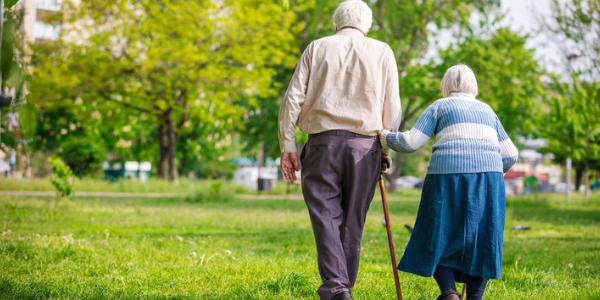
New research sheds light on why walking often becomes slower and more strenuous in old age. The findings suggest that the body gradually sacrifices some of its movement efficiency to ensure stability and an upright posture. It also became apparent that aging is associated with a “safety first” strategy when walking. This approach prioritizes stability over speed and energy efficiency, which explains why older adults may tire more quickly and are also at a higher risk of falling.
Walking Is More Complex Than We Thought
Walking is an activity that is often taken for granted. In fact, each leg can move rhythmically independently of the other and is controlled by the corresponding side of the spinal cord. However, the human brain’s ability to coordinate gait so that the legs of the walker are offset by half a step relative to each other—the so-called “antiphase”—is not so straightforward when an obstacle or asymmetry arises, such as a curve in the path. A better understanding of how a normal gait rhythm is maintained could lead to improved rehabilitation techniques for patients who have suffered a brain injury or other neurological problems.

In a study published in Communications Biology, researchers at Osaka University collected kinematic data from healthy participants walking on a treadmill that was occasionally disrupted by a sudden change in speed. This led to a temporary loss of the antiphase relationship, which was, however, quickly restored as the participants realigned their walking movements. The data from this experiment were analyzed using a mathematical model of two coupled oscillators—similar to two pendulums connected by a spring—as well as a Bayesian inference method. This approach enabled the researchers to calculate the most likely function describing how the brain coordinates leg movements.
To further simplify the problem, the phase reduction theory was applied, which assumes that the disturbed system returns to a regular periodic solution, the so-called limit cycle. Using Bayesian inference, the researchers were able to quantitatively deduce the control mechanism for leg coordination. Surprisingly, the experts found that the brain only actively controls the relative phase once the deviation from the correct antiphase alignment exceeds a certain threshold. In other words, the brain only actively intervenes to coordinate the relative position of the legs once they have already fallen out of sync to a certain extent. They suspect that avoiding constant control improves both energy efficiency and maneuverability. This research could be important for improving the gait of older adults or people suffering from the neurological consequences of a stroke or Parkinson’s disease. It could also lead to the development of assistive devices that help people walk more naturally.
How the Ankle Joint Changes with Age
But it’s not just neurological disorders that can affect gait. The natural aging process also changes the way we move. Another recent study shows the specific role played by the ankle joint and the surrounding muscles and explains why older adults increasingly prioritize stability over efficiency when walking.

Researchers at Flinders University analyzed movement data from 107 healthy adults aged 26 to 86. They identified small but significant age-related differences in how the ankle joint and surrounding muscles handle each step. The lead author and expert in sports and movement technology, Dr. Cody Lindsay, explained that the ankle joint is essential for maintaining balance while also helping to propel the body forward. “As we age, the body begins to prioritize stability over efficiency,” says Dr. Lindsay of the Flinders Caring Futures Institute. “This helps us stay upright, but it also makes walking more strenuous.”
The researchers found that older adults are more likely to activate opposing muscles around the ankle joint simultaneously. This pattern is known as co-contraction. It makes the ankle joint stiffer and can improve stability when the foot touches the ground. Dr. Lindsay points out, however, that this comes at a cost. The stiffening of the joint makes walking safer but also means that the muscles work harder without generating as much forward movement. Older participants also generated less propulsive force with each step. As a result, their strides were shorter and their walking speed was slower.
A “Safety First” Strategy for Walking
Co-author and associate professor Maarten Immink said the findings point to a broader shift in the way the body controls movement as people age. “The nervous system takes a ‘safety first’ approach and compensates for age-related changes by prioritizing stability over performance,” says Associate Professor Immink, director of the “Active Lives” research program at Flinders University’s Caring Futures Institute. “These changes can also increase fatigue and make it harder to walk longer distances, while at the same time reducing the ability to recover from stumbling or slipping—a key factor in falls among older adults.” Even gradual changes can affect self-confidence and independence, and those affected may notice that they tire more quickly or feel less secure, especially on uneven surfaces.
Exercise Can Help Maintain Mobility
The findings also offer potential approaches for helping people maintain their mobility for as long as possible as they age. This is not solely about strengthening muscles. Equally important are good balance, reliable coordination, and the ability to perform movements in a controlled and flexible manner. Exercise programs should therefore combine various aspects of mobility and take into account how muscles and joints work together during everyday movements such as walking.

Regular physical activity can help maintain the muscle strength and flexibility essential for walking. At the same time, balance and coordination exercises can help people react more confidently to different situations. This is particularly important for older adults, as uneven surfaces, sudden changes in direction, or minor stumbles can pose a greater challenge. Exercises such as tai chi, targeted training of the lower leg muscles, or activities that promote balance and coordination can therefore be beneficial. Everyday physical activity also plays an important role. Taking walks, climbing stairs, cycling, or engaging in other regular activities can help maintain physical performance. What matters most is not necessarily the intensity, but rather the regularity. People who stay active on a consistent basis may be able to prevent age-related changes in mobility and stability from having too great an impact on their daily lives.
Another important aspect is confidence in one’s own mobility. When people become increasingly unsteady while walking, they may avoid certain situations or move around less in general. This can lead to a further decline in physical performance. Targeted training can therefore not only improve physical condition but also help maintain a sense of security and self-confidence in daily life. The researchers’ findings could help design prevention and rehabilitation programs in a more targeted manner over the long term. Instead of merely training individual muscles, future approaches could focus more on improving the interaction between muscles, joints, balance, and the nervous system. The goal would be to maintain the ability to walk safely, efficiently, and independently even in old age, thereby reducing the risk of falls.
Staying active is therefore one of the most important ways to support one’s mobility as one ages. Even small, regular exercises can help maintain strength, balance, and coordination for longer. The researchers hope that their findings will help enable people to lead self-confident, safe, and independent lives even in old age.