
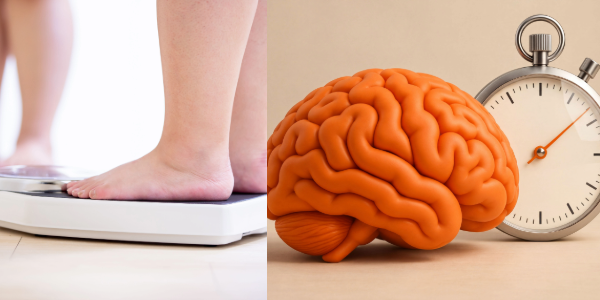
Weight gain is one of the changes that particularly concerns many women during and after menopause. But excess weight could affect far more than just a person’s outward appearance. A long-term study involving more than 8,200 adults suggests that a persistently higher body weight may also be linked to a more rapid decline in cognitive function. The findings are particularly interesting for middle-aged and older adults. The study included both women and men. Nevertheless, its results are especially revealing for middle-aged women, as body weight, fat distribution, and metabolism often change during menopause.
Observed Over 24 Years: What the Researchers Found
Many women are familiar with the problem: While it used to be relatively easy to maintain their weight, their bodies suddenly seem to change during midlife. Fat distribution shifts, waist circumference increases, and even with consistent eating habits, the scale sometimes shows a higher number. Menopause brings numerous hormonal changes that can also affect metabolism and body composition. At the same time, one topic is increasingly coming into focus in health research: the question of how body weight affects long-term brain health.

A new study from the University of Georgia provides interesting insights on this topic. The researchers found a link between a consistently elevated body mass index (BMI) over an extended period and a faster decline in various cognitive abilities. These included memory, concentration, and the ability to perform complex tasks. For the study, the research team analyzed data from more than 8,200 adults. The participants were at least 50 years old at the start of the study and were followed over a period of 24 years. About 58 percent of the participants were women. The data came from the U.S. Health and Retirement Study, a large-scale, long-term study that examines the health, aging, and living conditions of older adults.
The scientists’ approach was particularly interesting: They did not merely consider body weight at a single point in time, but instead examined the average BMI over a longer period. This allowed them to better understand how a consistently higher body weight might affect the development of cognitive function. The result: People with a higher long-term BMI showed a more pronounced decline in their cognitive abilities over the years. The level of BMI also appeared to play a role. Even a one-point increase in BMI was statistically associated with a faster decline in cognitive function. The researchers observed the strongest correlations approximately eight years after the corresponding BMI measurements. The effects were particularly pronounced in people over the age of 65.
Memory, Concentration, and Decision-Making Ability May be Affected
When people talk about cognitive decline, many initially think of increasing forgetfulness. In fact, however, mental performance encompasses much more than just remembering names, appointments, or information. The researchers examined various areas of brain function. These included memory, general cognitive performance, and what are known as executive functions. The latter are particularly important for everyday life. They help us plan tasks, make decisions, organize multiple things at once, and direct our attention effectively.
When these abilities decline, it can manifest, for example, in everyday activities taking longer, concentration waning more quickly, or finding it harder to process complex information. A certain decline in mental performance is part of the natural aging process. However, the study results suggest that long-term obesity may accelerate this process.
Why Obesity Might Affect the Brain
The scientific reasons why higher body weight is associated with a faster decline in mental performance have not yet been fully elucidated. There are, however, several biological explanations. Chronic inflammatory processes could play an important role. Excess adipose tissue is by no means merely an energy store. It also produces various signaling molecules that can influence inflammatory reactions in the body. If such processes persist over a long period, they may also impair the function of blood vessels and nerve cells.

Another possible factor is insulin resistance. In this condition, the body’s cells become increasingly less responsive to the hormone insulin, which normally ensures that sugar can be taken up from the blood into the cells. Impaired insulin regulation not only affects blood sugar metabolism but could also have an impact on processes in the brain. Added to this are possible changes in blood flow, which is also important for supplying the brain with oxygen and nutrients. Several of these factors can occur simultaneously and reinforce one another. However, the current study did not directly investigate these mechanisms. Rather, they point to possible explanations for the observed association.
Why Menopause Might Play a Special Role
This topic is particularly interesting for women in midlife. As estrogen production declines during menopause, it is not only the menstrual cycle that changes. Metabolism, fat distribution, and muscle mass can also be affected. Many women notice that fat increasingly accumulates in the abdominal area. At the same time, muscle mass can be lost, especially if physical activity and strength training are not adequately addressed. These changes are not solely attributable to diet. Hormonal changes influence various metabolic processes and can contribute to alterations in energy expenditure and body composition.
The brain also reacts to these hormonal changes. Estrogen is involved in various processes that affect, among other things, memory, signal transmission between nerve cells, and blood flow to the brain. During the transition to menopause, many women therefore report difficulty concentrating, forgetfulness, or the feeling that they are less mentally resilient. The term “brain fog” is often used to describe this.
These symptoms are not automatically a sign of early-stage dementia. Sleep disturbances, hot flashes, psychological stress, and hormonal changes can temporarily affect mental performance. However, the new long-term study did not specifically examine women going through menopause and does not provide direct evidence that the decline in estrogen and weight gain together accelerate cognitive decline. It does, however, make it clear that body weight could be another factor that should be taken into account when considering long-term brain health.
It’s Not Just the Number on the Scale That Counts
An important point is that the body mass index (BMI) alone has limited significance. It relates body weight to height but does not take into account the composition of that weight. For example, two women can have the same BMI even though their body composition differs significantly. A woman with a higher percentage of muscle mass, for instance, may have the same BMI as a woman with a higher percentage of body fat.
This is why the distribution of body fat becomes particularly important after menopause. Belly fat—especially so-called visceral fat in the abdominal cavity—is associated with various metabolic and cardiovascular risks. For health assessment, waist circumference, blood pressure, blood sugar levels, and blood lipid levels can therefore provide important insights in addition to BMI. Above all, the study underscores the importance of long-term weight trends. A single reading on the scale says little about how a person’s health will develop over many years.
Weight Management Could also Benefit Brain Health
The researchers see their findings not only as an indication of potential risks but also as an opportunity. Since body weight can be influenced by various lifestyle factors, improving weight management could potentially help maintain cognitive function for longer. The study also noted that changes in weight management could be associated with a more favorable trend in cognitive performance within as little as two years. This is an interesting perspective. However, it does not mean that weight loss has been proven to protect against dementia. The study cannot prove a causal relationship and does not constitute clinical evidence of such a protective effect.

Nevertheless, there are good reasons to pay attention to a healthy metabolism, especially in middle age. Regular exercise can help improve insulin sensitivity, promote blood circulation, and maintain muscle mass. Strength training, in particular, becomes increasingly important after menopause because it can counteract age-related muscle loss. A balanced diet rich in vegetables, fruits, legumes, whole grains, high-quality protein sources, and healthy fats also supports overall metabolic health. Last but not least, adequate sleep, social interactions, and mental activity play an important role in well-being and healthy aging.
Brain Health Begins Long Before Retirement Age
The findings from the University of Georgia make it clear that being overweight may not only have physical consequences. The long-term development of cognitive function may also be linked to body weight and metabolic health. For women during and after menopause, this is an additional reason to take a holistic view of their own health. This is because, especially during this phase of life, numerous physical processes change that can have a long-term impact on well-being and health. This should by no means be about conforming to a specific ideal of beauty or viewing every extra kilogram as a problem. Far more important is the question of how to maintain one’s health over the long term. This includes preserving muscle mass, maintaining good metabolic function, and managing key risk factors such as high blood pressure, elevated blood sugar levels, and unfavorable blood lipid levels.
Regular exercise plays a central role in this. A combination of endurance training and strength training can help maintain physical performance, support metabolism, and counteract age-related muscle loss. Strength training, in particular, becomes increasingly important for women after menopause, as the loss of muscle mass with age can affect energy expenditure and physical endurance.
Diet also deserves attention. A varied diet rich in vegetables, fruits, whole grains, legumes, nuts, and high-quality protein sources provides the body with essential nutrients. At the same time, it can help maintain healthy blood sugar and lipid levels. In addition, the importance of sufficient sleep and regular periods of rest should not be underestimated, as these are also crucial for mental performance and metabolism. Alongside these physical factors, the brain also needs regular stimulation. Learning new things, staying mentally active, maintaining social connections, and engaging in tasks that require concentration and attention can all be important components of an active lifestyle.
Research increasingly shows that healthy aging does not begin only in old age. Middle age, in particular, offers an important opportunity to develop habits that can benefit the body and brain in the long term. For women, this also means viewing menopause not merely as a phase of hormonal changes, but as a stage of life in which the course can be set for health in the coming decades.