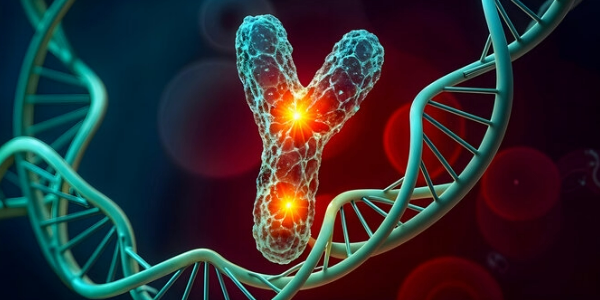
As men age, some of their cells gradually lose the Y chromosome. For a long time, scientists assumed that this change would have little impact. Since the Y chromosome contains relatively few genes beyond those involved in male development, its absence was not expected to affect overall health. This view has changed. Research findings from recent years show that the loss of the Y chromosome is linked to serious health problems throughout the body and may contribute to a shorter life expectancy.
How Common is the Loss of the Y Chromosome?
Advances in genetic diagnostics have shown that the loss of the Y chromosome is widespread among older men. This pattern intensifies with increasing age: About 40% of men in their sixties show some degree of loss, and by age 90, this proportion rises to 57%. Environmental factors such as smoking and exposure to carcinogens can increase the likelihood of this change.

The loss does not occur in every cell. Instead, a mixture of cells with and without the Y chromosome develops, a condition known as mosaicism. Once a cell loses the Y chromosome, it is also missing from all of its future descendants. Laboratory studies suggest that cells without the Y chromosome may grow faster than normal cells, which could give them an advantage in tissues and even in tumors.
The Y chromosome is particularly vulnerable during cell division. It can be accidentally excluded and left behind in a small, membrane-bound structure that is later degraded. For this reason, Y chromosome losses tend to accumulate in tissues where cells divide rapidly.
Why a Small Chromosome Matters
The human Y chromosome is unusual. It contains only 51 protein-coding genes (excluding duplicate copies), compared to thousands on other chromosomes. Its known functions include determining male sex and supporting sperm production, but for a long time it was assumed that it had only limited functions beyond that. In the laboratory, cells can lose the Y chromosome and still survive, reinforcing the idea that it is not essential for basic cellular functions. In fact, some marsupials lose the Y chromosome early in development, and in mammals, the chromosome has been shrinking for about 150 million years. In certain rodents, it has even disappeared and been replaced. Given this history, the loss of the Y chromosome later in life was once considered insignificant.
Links to Disease and Shorter Life Expectancy
Contrary to earlier assumptions, a growing body of evidence suggests that the loss of the Y chromosome is associated with serious health problems. Studies have linked it to cardiovascular diseases, neurodegenerative disorders, and cancer. For example, a greater loss of the Y chromosome in kidney cells is associated with kidney disease. Large population studies have also shown that men over 60 with a higher number of Y-chromosome-deficient cells are at a higher risk of heart attacks.
The loss of the Y chromosome has been linked to worse COVID-19 outcomes, which may explain why men have higher mortality rates. It also occurs significantly more frequently in people with Alzheimer’s disease. Furthermore, several studies show associations between Y chromosome loss and various types of cancer, as well as poorer survival rates in affected patients. Cancer cells themselves often exhibit this chromosomal loss alongside other abnormalities.
Cause or Consequence?
It remains difficult to determine whether the loss of the Y chromosome directly causes diseases or merely occurs in parallel with them. In some cases, diseases or tissue repair can lead to increased cell division, which could raise the likelihood of chromosomal loss. Genetic factors also appear to play a role. Research findings suggest that about one-third of the variation in Y-chromosome loss is inherited, involving approximately 150 genes related to cell cycle control and cancer risk.
However, experimental evidence points to a more direct effect. In one study, mice administered Y-deficient blood cells developed increased age-related diseases, including reduced heart function and eventually heart failure. There are also signs that the loss of the Y chromosome can directly influence the behavior of cancer. In some cases, it can promote tumor growth and aggressiveness, including in ocular melanoma, which is more common in men.
What the Y Chromosome Does in the Body
The health effects associated with the loss of the Y chromosome suggest that it plays a more comprehensive role than once assumed. But how can a chromosome with so few genes have such a far-reaching effect? A key gene, SRY, is active in many tissues throughout the body. Its known role in the brain includes involvement in Parkinson’s disease. Four other genes are active only in the testes and are essential for sperm production.

In addition, many of the remaining genes on the Y chromosome are active in various tissues and contribute to the regulation of gene expression. Some act as tumor suppressors. These genes also have counterparts on the X chromosome, meaning that both men and women typically possess two copies of them. When cells lose the Y chromosome, they may be left with only one copy, which could disrupt normal gene regulation.
The Y chromosome also contains numerous non-coding genes. These produce RNA molecules that are not converted into proteins but can influence the function of other genes. This could explain why the Y chromosome can influence activity in many parts of the genome. It has been shown that the loss of the Y chromosome alters gene expression in blood-forming cells and in cells involved in immune responses. It could also affect the development of blood cells and heart function.
The human Y chromosome was only recently fully sequenced. As research continues, scientists will likely learn more about how its genes contribute to health and disease and why its loss can have such significant effects.
Related Posts
-

Pancreatic cancer is still one of the deadliest forms of cancer. It has a higher…
-
When it comes to cancer, aging is a double-edged sword, as researchers are increasingly realizing.…
-
Approximately 13 out of every 100 men in the United States is diagnosed with prostate…