
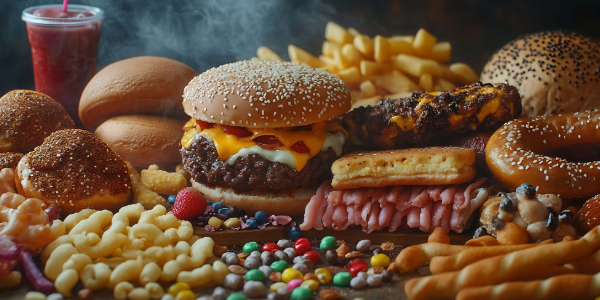
When people think about the consequences of a diet high in ultra-processed foods, they probably first think of obesity, blood sugar levels, or cardiovascular disease. A new study now draws attention to a less obvious area: the thigh muscles.
Researchers have discovered a striking correlation in people at increased risk for knee osteoarthritis. The higher the proportion of ultra-processed foods in their diet, the more fat was found within the thigh muscles. What’s remarkable is that the correlation remained even after the researchers accounted for factors such as calorie intake, physical activity, body mass index, and other variables.
The findings come from an analysis of 615 adults and were published in the journal *Radiology*. The study thus provides further evidence that health in old age may depend not only on how much we eat, but also on what we eat.
Fat Can Hide Where You Least Expect it
Fat on the abdomen or hips is visible from the outside. Fat inside a muscle, on the other hand, remains invisible at first. It was precisely this form of fat deposition that was the focus of the new study. Using MRI scans, the researchers examined the participants’ thigh muscles. Their focus was not on the fat tissue under the skin, but on fat located within the muscle tissue.

On the images, such changes can be seen as streaks of fat or fatty areas within the muscle tissue. A muscle then no longer consists exclusively of densely packed muscle fibers but increasingly contains fat. In medical research, this is referred to as muscle-fat infiltration or intramuscular fat deposition.
This is relevant to aging because muscle mass and muscle quality are two different things. For example, a person may still have relatively normal muscle mass, while the quality of the muscle tissue is already declining.
Muscles Don’t Just Get Weaker
As we age, our muscles change. Muscle mass can decrease, strength wanes, and movements may become slower. However, muscle health cannot be assessed solely based on muscle size. The composition of the muscle tissue and how well it functions are also crucial factors.
If fat increasingly accumulates within the muscles, this can be accompanied by poorer muscle quality. This is particularly relevant for the thighs, because these muscles play a central role in walking, standing up, climbing stairs, and stabilizing the knee joint.
Especially in older age, the combination of reduced strength, poorer muscle quality, and joint problems can become a vicious cycle. People who experience knee pain may move less. Less movement, in turn, can lead to further muscle weakness. Weaker muscles can alter the load on the knee joint. The new study now suggests that diet may also be linked to the quality of the thigh muscles.
615 People and a Surprising Look Inside Muscle Tissue
For the study, the scientists drew on data from the Osteoarthritis Initiative. This is a large-scale research program that investigates how knee osteoarthritis develops, how it progresses, and which factors play a role. A total of 615 people were selected for the current analysis. The group consisted of 275 men and 340 women
The average age was around 60 years. The average BMI was 27, placing them in the overweight range. Importantly, however, at the time of the MRI scans used for this study, the participants showed no radiological signs of knee osteoarthritis.
In other words, the researchers did not simply examine people with already severely damaged knees. They studied individuals who were at increased risk for knee osteoarthritis but who, at that point in time, did not yet show any corresponding changes on the images. This makes the question of prevention particularly interesting.
What Exactly are Ultra-Processed Foods?
The participants had provided information about their diets. This data was used to determine what proportion of their daily diet consisted of ultra-processed foods. On average, 41.4 percent of the foods consumed—or the corresponding dietary intake—were classified as ultra-processed. The researchers didn’t simply ask, “Do you eat a lot of fast food?” Instead, the diet was systematically classified using the so-called NOVA system. This system categorizes foods based on the extent to which they have been processed.

Ultra-processed foods are more than just “processed foods.” A piece of cheese, frozen vegetables, or whole-grain bread has also been processed. That does not automatically mean it is an ultra-processed product. Ultra-processed foods, rather, refer to products that have been heavily modified industrially and are often made from a combination of various ingredients. These may include, for example, flavorings, colorings, sweeteners, emulsifiers, or other additives.
Typical examples include:
- Soft drinks and many energy drinks
- Candy and industrially produced desserts
- Prepackaged snacks
- Certain breakfast cereals
- Frozen pizza
- Many ready-to-eat meals
- Hot dogs and other highly processed meat products
- Industrially produced baked goods
- Various prepackaged bread and roll products
- Certain spreads and margarine products
However, it’s important to note that not every product containing an additive is automatically “unhealthy,” and the category of ultra-processed foods is very broad. Therefore, what matters is not a single food item but the overall dietary pattern. Previous studies have already found links between high consumption of highly processed foods and muscle health. The risk of sarcopenia may also be increased.
The More Ultra-Processed Foods, the More Fat in the Muscles
In the current study, the researchers found a statistical association between the proportion of ultra-processed foods in the diet and the amount of fat within the thigh muscles. Simply put: The higher the proportion of ultra-processed foods in the diet, the more pronounced the fat infiltration of the thigh muscles was.
This association was evident when examining all thigh muscles studied and, in particular, in certain muscle groups such as the flexors and adductors. The association persisted even after adjusting for BMI. When waist circumference was used instead of BMI, the statistical associations were even stronger. It is particularly interesting that the researchers did not simply observe an association with body weight. Rather, the data suggest that dietary quality may be linked to the composition of muscle tissue.
Why this Could be Important for the Knees and Mobility
The thigh muscles are crucial for knee function. They enable leg movement and help stabilize the knee during everyday activities. The muscles on the front of the thigh, in particular, play a key role in standing up, walking, and climbing stairs. If muscle quality declines, it can affect the function of the entire musculoskeletal system.
Knee osteoarthritis, in turn, affects more than just the cartilage. Today, it is considered a condition involving various structures—including bone, the synovial membrane, adipose tissue, and muscle. Changes in muscle composition could therefore be part of a larger interplay. The researchers point out that increased fat infiltration of the thigh muscles could potentially contribute to the development or progression of knee osteoarthritis. However, this is a possible explanation and not a cause-and-effect relationship proven by this study.
The Interesting Question: Is Diet More Important than Calories?
One of the most intriguing questions raised by the study is therefore not just: How many calories do we eat? But rather: From which foods do these calories come? The researchers accounted for daily calorie intake in their statistical models. Nevertheless, the association between the consumption of ultra-processed foods and fat infiltration of the muscles persisted.
Physical activity was also taken into account. This does not mean that calories or exercise are unimportant. Quite the contrary: body weight and physical activity are important factors for the health of muscles and joints. However, the results suggest that the quality of one’s diet could provide additional information that is not revealed by calorie counting or weight measurement alone. This is particularly relevant for healthy aging.
A Normal BMI Doesn’t Tell the Whole Story
BMI is a simple and useful measure, but it has a well-known weakness: It reveals little about what body weight is composed of. Two people can have the same BMI and still have completely different body compositions. For example, one person may have more muscle mass and less body fat, while the other may have less muscle mass and a higher percentage of fat.
The new study takes this line of thinking even further. Even within the muscles themselves, the composition can vary. A muscle may appear normal on the outside, while more fat has already accumulated inside. It is precisely these kinds of changes that can be visualized using imaging techniques such as MRI.
Why the MRI Scans Are Particularly Interesting
Conventional, non-contrast-enhanced MRI scans were used for the study. This is interesting because MRI scans can reveal more than just bones and joints; they also provide insight into the composition of soft tissues and muscles. The researchers see this as an advantage for future studies.
If such imaging techniques can be used more extensively in the future to assess muscle quality, it might be possible to examine more precisely how diet, exercise, age, and diseases influence one another. This does not mean that everyone needs to have an MRI of their thighs on a regular basis. Rather, such examinations can help researchers visualize changes in the body that cannot be detected through simple measurements like weight, BMI, or waist circumference.
Why Age Plays a Role
As we age, maintaining muscle mass becomes increasingly important. Muscles aren’t just for athletic performance. They determine whether we can stand up on our own, go shopping, climb stairs, or take a long walk. When muscle strength and mobility decline, the risk that everyday activities will become more difficult increases.
Knee problems can further accelerate this process. Pain often leads people to avoid movement, which in turn reduces the strain on the muscles. As the muscles weaken, certain movements can become even more difficult.
That’s why the combination of exercise, muscle strength, body weight, and diet is particularly important for healthy aging. The new study adds another factor to this equation: the quality of the foods we eat regularly.
What Might be Behind this Connection?
The study cannot explain why a higher intake of ultra-processed foods was associated with higher muscle fat. However, there are several possible explanations. A diet high in ultra-processed foods may contain fewer overall dietary fibers, certain micronutrients, and other components that are more common in a varied diet consisting of minimally processed foods. At the same time, many ultra-processed foods contain relatively high amounts of calories, salt, sugar, or unfavorable fat combinations.
Such a diet can also contribute to overweight. Furthermore, metabolic processes, inflammatory responses, and changes in body composition are discussed as possible links between diet and muscle quality. However, the current study cannot determine which of these mechanisms is actually responsible for the observed association. It would therefore be incorrect to claim that a specific additive or a single ready-made meal directly “adds fat” to the thigh muscles.
It’s Not About a Single Frozen Pizza
This is an important distinction. The study does not examine a single meal or a specific product. Instead, it looks at the proportion of ultra-processed foods in the overall diet. Therefore, someone who occasionally eats a frozen pizza or buys a chocolate bar does not need to assume that this will impair muscle quality.
A more problematic scenario would be a dietary pattern in which highly processed products make up a very large portion of the daily diet and increasingly displace fresh or minimally processed foods. For health in old age, therefore, the decisive question is likely not whether one should never eat a certain food. A more interesting question is: What does one’s diet look like over the course of weeks, months, and years?
Diet and Exercise Go Hand in Hand
The study also provides no reason to pit diet against exercise. On the contrary. Regular physical activity is crucial for muscle health. Strength training can help maintain muscle strength and mass. Endurance exercise supports, among other things, overall fitness and mobility.
At the same time, a balanced diet provides the energy and nutrients the body needs to maintain and repair tissue. This combination can be particularly important as we age. After all, someone who is very active but consistently follows a very unbalanced diet may not have the same health advantages as someone who combines exercise with a nutrient-rich diet.
What the Study Does Not Prove
As interesting as the results are, they should not be overinterpreted. The study was cross-sectional, meaning the researchers examined dietary data and MRI scans taken at a specific point in time. This makes it impossible to determine which factor came first. For example, it is possible that a high intake of ultra-processed foods contributes to poorer muscle quality.
However, it is also conceivable that people in poorer physical condition change their diet and more frequently turn to ready-to-eat products that are easy to prepare. Or multiple factors may simultaneously influence both diet and muscle quality. The study can therefore demonstrate an association but cannot prove a clear cause-and-effect relationship.
Furthermore, while the sample size of 615 participants is considerable for an MRI-based study, it is significantly smaller than in large epidemiological dietary studies. Finally, the dietary data are based on participants’ self-reports covering the past year. Such dietary questionnaires are helpful but can never record every meal and every portion size with complete accuracy.
Further Evidence that “Healthy Weight” isn’t Everything
The study is nonetheless interesting for research on healthy aging. For a long time, research on nutrition and aging focused primarily on body weight, BMI, and calorie intake. But the body is more complex. Two people of the same weight can have different amounts of muscle mass, body fat, and fat distribution. And even two people with similar muscle mass can have different muscle quality.
The new study shows how modern imaging can reveal such differences. Perhaps the most important takeaway, therefore, is this: healthy aging isn’t just about gaining as little weight as possible. It also means maintaining muscle quality and mobility for as long as possible.
What You Can Take Away from This for Everyday Life
A single study cannot be used to derive a perfect anti-aging diet. However, the results align with a generally sound dietary pattern: as many nutrient-rich, minimally processed foods as possible, and fewer ultra-processed products. On your plate, for example, vegetables, fruits, legumes, whole grains, nuts, seeds, and—depending on your personal dietary preferences—appropriate protein sources can play a greater role.

At the same time, no one needs to strive for a diet that bans every industrially produced food. What matters is the big picture. Exercise is also crucial for muscle health. Regular strength training and daily physical activity are important building blocks—especially in older age—for maintaining strength, balance, and independence.
The new study highlights something that is becoming increasingly interesting in the field of aging research: Some changes in the body cannot be detected on the scale. A person can look relatively healthy on the outside and still develop changes in muscles and other tissues. Imaging techniques such as MRI make such changes visible.
The researchers therefore see a potential benefit in investigating more closely in the future how diet, muscle quality, and joint health are interrelated. However, whether consuming fewer ultra-processed foods actually helps prevent fat infiltration in the muscles or reduces the risk of developing knee osteoarthritis later in life must first be clarified through long-term studies.
Don’t Just Look at the Scale
The new study draws attention to a potentially underestimated aspect of nutrition. In people at increased risk for knee osteoarthritis, higher consumption of ultra-processed foods was associated with more fat within the thigh muscles. This association remained even after various important factors were taken into account. This does not mean that ready-to-eat meals automatically cause knee osteoarthritis. Nor does the study prove that a change in diet can reverse fat infiltration in the muscles.
However, it does provide an interesting indication that dietary quality, muscle quality, and joint health may be more closely linked than previously thought. This is an important perspective, especially for healthy aging. After all, when it comes to staying mobile and independent for as long as possible, it’s not just the number on the scale that matters. It also depends on how well the muscles that support our bodies every day function.
Related Posts
-

Ultra-processed foods (UPFs) are heavily modified industrial products that contain added fats, sugars, starch, salts,…
-
A recent study led by researchers at the University of the Sunshine Coast (UniSC) suggests…
-
Menopause brings many new changes and possible issues within the female body. Though more challenging…