Colorectal cancer is the second leading cause of cancer-related deaths worldwide. When detected early, it is often highly treatable. However, colonoscopies—the most common screening test today—can be costly and uncomfortable, which discourages many people from getting screened in a timely manner. Researchers at the University of Geneva (UNIGE) have developed a new approach that could change this. Using machine learning, they created the first detailed catalog of all human gut bacteria, which is so precise that it provides insight into how different microbial subgroups function in the body. They then used this information to detect colorectal cancer based on bacteria in simple stool samples, offering a non-invasive and cost-effective alternative. The results, published in Cell Host & Microbe, could also help scientists better understand how the gut microbiota influences overall health and disease.
Colorectal Cancer: Why Better Screening Tools Are Needed
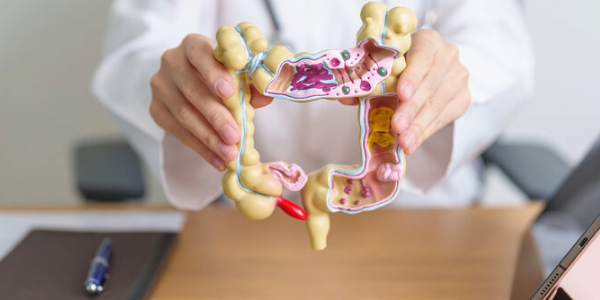
Colorectal cancer is a malignant tumor disease of the colon or rectum. In most cases, it develops slowly from initially benign growths on the intestinal lining, known as polyps, which can change over the course of years. Precisely because this process often goes unnoticed for a long time, early detection plays a crucial role.
The risk increases significantly with age—most cases occur in people aged 50 and older. Other risk factors include a family history of the disease, obesity, lack of physical activity, a diet low in fiber, and high consumption of red or processed meat and alcohol. Colorectal cancer is one of the most common types of cancer in Europe, affecting both men and women, although the disease is slightly more common in men.
Typical symptoms often do not appear until the disease has reached advanced stages. These include changes in bowel habits (e.g., persistent diarrhea or constipation), blood in the stool, unexplained abdominal pain, weight loss, or persistent fatigue due to anemia. Since these signs can be nonspecific, it is particularly important to undergo screening—because when detected early, the chances of recovery are generally very good.
Many cases of colorectal cancer are diagnosed late, when treatment options are already limited. This underscores the urgent need for simpler and less invasive screening methods, especially since the number of cases among younger adults continues to rise for reasons that remain unclear. Scientists have long known that the gut microbiota plays a role in colorectal cancer. However, it has been difficult to translate this knowledge into practical medical tools. A major challenge is that different strains within the same bacterial species can behave very differently. Some may contribute to the development of cancer, while others have no effect at all.
Focus on Subspecies of the Microbiota
The gut microbiota refers to the totality of all microorganisms living in our gut. These include primarily bacteria, but also viruses, fungi, and other microbes. Every person carries billions to trillions of them—they form a complex ecosystem of their own that works closely with our body. These microorganisms perform important functions: they aid digestion, produce certain vitamins, train the immune system, and even influence metabolic processes. At the same time, they are in constant interaction with the body. If this balance is disrupted—for example, by diet, medications, or illness—it can affect health and be linked to various diseases.
“Instead of relying on the analysis of the various species that make up the microbiota—which does not capture all significant differences—or on bacterial strains that vary greatly from individual to individual, we focused on an intermediate level of the microbiota, namely the subspecies,” explained Mirko Trajkovski, full professor at the Institute of Cell Physiology and Metabolism and at the Diabetes Center of the UNIGE Faculty of Medicine, who led this research. “Distinguishing at the subspecies level is specific enough to capture differences in how bacteria function and their contribution to diseases such as cancer, yet general enough to detect these variations across different groups of people, populations, or countries.”
Decoding the Gut with Machine Learning
The research required the analysis of massive amounts of biological data. “As a bioinformatician, the challenge was to develop an innovative approach to big data analysis,” said Matija Trickovic, a PhD student in Trajkovski’s lab and first author of the study. “We have successfully developed the first comprehensive catalog of the subspecies of the human gut microbiota, along with a precise and efficient method for applying it in both research and clinical settings.”
The researchers use algorithms trained to recognize patterns in these massive datasets. To do this, the system is fed many known samples—such as those from healthy individuals and from patients with specific diseases. The algorithm learns which combinations of bacterial subspecies are typical of certain conditions, even if these differences would be barely visible to the human eye.
The “catalog” mentioned here is a kind of reference database: it contains systematically recorded information about which microbial subspecies occur in the gut and how they differ. Combined with the machine learning algorithms, this creates a tool that can quickly classify new samples. This makes the method valuable not only for research but also for clinical practice—for example, to detect diseases earlier, assess risks, or better tailor therapies to individual patients.
A Stool Test that is Every Bit as Good as a Colonoscopy
By combining their bacterial catalog with existing clinical datasets, the team developed a model capable of detecting colorectal cancer based solely on stool samples. The results exceeded expectations. “Although we were confident in our strategy, the results were impressive,” said Matija Trickovic. “Our method detected 90% of cancer cases—a result that is very close to the 94% detection rate achieved with colonoscopies and is better than all current non-invasive detection methods.” With additional clinical data, the model could become even more accurate and eventually match the performance of colonoscopy. In practice, this type of test could be used for routine screenings, with colonoscopies reserved for confirming positive cases.
The key advantage is that this approach is non-invasive while simultaneously utilizing a wealth of biological information. While traditional stool tests typically look only for blood, this method analyzes complex changes in the gut’s microbial ecosystem. As a result, it can also detect earlier or more subtle signs of pathological processes. In practice, the goal would be to use such tests widely for preventive care and to follow up with a more detailed examination—such as a colonoscopy—only in cases of abnormal results.
Beyond Cancer Detection
A clinical study is currently being prepared in collaboration with the Geneva University Hospitals (HUG) to more precisely define which stages of cancer and lesions can be detected using this method. The implications extend far beyond colorectal cancer. By examining differences between subspecies within the same bacterial species, researchers can begin to uncover how gut microbes influence a wide range of health conditions. “The same method could soon be used to develop non-invasive diagnostic tools for a variety of diseases, all based on a single microbiota analysis,” says Mirko Trajkovski.
The innovative approach of this study lies in not merely distinguishing roughly between bacterial species, but in examining subspecies in greater detail. These provide significantly more precise information about which microbial processes are occurring in the body. In the future, this could allow for the identification of specific “microbiome profiles” that indicate, for example, metabolic diseases, inflammatory processes, or even neurological disorders. The major advantage: A single stool sample could be sufficient to simultaneously provide indications of various health risks.
In the long term, this could fundamentally transform medical diagnostics. Instead of many individual tests for different diseases, it would be conceivable to use a comprehensive analysis of the gut microbiota as a routine examination. This would allow doctors to intervene earlier, tailor treatments more individually, and better monitor disease progression. This development is still in its infancy, but it demonstrates how strongly personalized medicine and modern data analysis—such as through machine learning—could shape preventive care in the future.
Related Posts
-

Pancreatic cancer is the fourth-leading cause of cancer deaths in the United States and is…
-
A variety of different types of lung cancer is possible for older men. Understanding why…
-
It has been found that postmenopausal women who are given a certain type of hormone…