
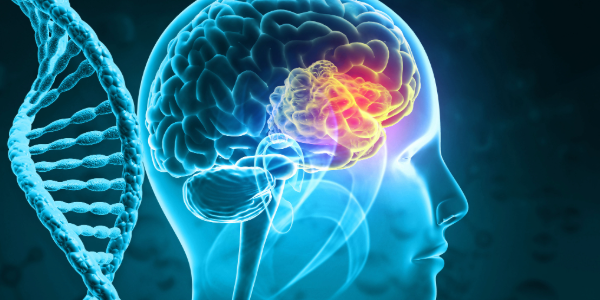
Menin is at the center of an unusual research idea: Experiments on mice show that changes in a protein in the hypothalamus are linked to inflammation, memory problems, thinner skin, and reduced bone mass. D-serine also plays a role—but researchers are still a long way from developing an anti-aging therapy for humans. What do declining memory, thinner skin, and weaker bones have in common? At first glance, not much. But there may be a biological connection in the brain between these typical signs of aging.
Menin is a protein found in the cell nucleus of vertebrates and insects that plays an important role in transcription regulation, DNA repair, and the control of cell growth. For several years, scientists have been investigating the function of menin in the hypothalamus—a small region of the brain that regulates, among other things, metabolic processes and numerous basic bodily functions. A study published in PLOS Biology in 2023 revealed a remarkable correlation in mice: when menin levels decrease in certain nerve cells of the hypothalamus, increased inflammation and various age-related changes occur. When Menin levels were experimentally restored in older mice, several of these characteristics improved.
Why the Hypothalamus is of Particular Interest
Although the hypothalamus is small, it performs a wide range of important functions. Among other things, it influences metabolism, the endocrine system, energy balance, and other processes that are crucial for the body’s equilibrium. Even before the menin study, researchers had evidence suggesting that inflammatory processes in the hypothalamus might be linked to changes that extend far beyond the brain.
The scientists therefore investigated whether menin plays a protective role in this process. In older mice, they did indeed find lower levels of menin in certain nerve cells of the so-called ventromedial hypothalamus. This region is involved, among other things, in regulating metabolism. Notably, the decline did not occur to the same extent in all cells of the region. In astrocytes and microglia—cells that are important, among other things, for support and immune defense in the brain—this specific decline was not observed.
What Happens When Menin is Missing?
To go beyond simply observing a correlation and to investigate the potential influence of menin more closely, the researchers genetically modified mice. They were able to specifically reduce menin levels in certain cells. The result was striking: in animals that were actually young, inflammatory processes in the hypothalamus intensified. At the same time, the mice developed several characteristics normally associated with advancing age.
These included:
- lower bone mass,
- thinner skin,
- poorer performance on certain cognitive tasks,
- changes in balance and coordination,
- and a slightly shorter lifespan.
The results thus suggest that the loss of Menin may be more than just a mere side effect of aging. It could be involved in certain age-related changes. However, this mechanism has not been proven in humans.
A Link Between Encephalitis and Memory
During their investigations, the researchers also discovered a connection to D-serine. This is an amino acid involved in the function of certain receptors in the brain. These receptors play an important role in communication between nerve cells and in the processes through which neural connections are modified and memories are stored.
In mice with reduced levels of menin, D-serine levels were lower. At the same time, an enzyme involved in the production of D-serine was less active. This suggests a possible second mechanism: Menin could influence cognitive functions not only by regulating inflammation but also through metabolic processes that are important for signal transmission between nerve cells. The study became particularly interesting when the scientists took the opposite approach.
They increased menin production in the hypothalamus of approximately 20-month-old mice. To do this, they specifically introduced the corresponding gene into this brain region. Just 30 days later, the treated animals showed improvements in several measured characteristics, including skin thickness and bone mass. Better results were also observed in tests of learning, cognition, and balance. In addition, higher levels of D-serine were detected in the hippocampus. The hippocampus is a brain region that is particularly important for learning and memory. The original study also reported that restoring Menin extended the lifespan of the treated mice
D-serine Improved Cognitive Function – But Not the Overall Aging Process
The researchers then wanted to know whether D-serine itself could explain some of the effects. To investigate this, mice were given the amino acid in their drinking water for three weeks. Performance on cognitive tests improved, even in older animals. However, one crucial difference remained: D-serine did not lead to the same comprehensive changes in physical signs of aging as the restoration of menin. This means that the study did not show that D-serine can reverse the entire aging process. Rather, the results suggested a possible influence on certain cognitive functions.
Serine is found in foods such as soybeans, eggs, fish, and nuts, among others. However, the form found in the body’s own proteins is L-serine. D-serine is a different form of the amino acid. Although the body can convert L-serine into D-serine, this does not mean that consuming certain foods has the same effect as the experimental administration of D-serine. The mouse experiments therefore do not provide evidence that a specific diet or a D-serine dietary supplement slows the human aging process.
New Studies Make the Picture Even More Complex
Since the original Menin study, additional research has been published examining related biological processes. A cell study published in 2024 investigated Menin in cultured mouse hippocampal cells. In that study, the substance itaconate was able to increase Menin levels and reduce certain inflammatory and cell damage processes. When Menin was inactivated, however, this protective effect disappeared.
This is an interesting clue to the protein’s biological function. However, this was a cell culture study and does not prove that such treatment slows aging in a living animal or a human. Other researchers have since investigated communication between the hypothalamus and the rest of the body. For example, a study published in Cell Metabolism in 2024 examined another group of hypothalamic neurons that communicate with adipose tissue. In mice, changes to this system affected, among other things, physical activity and lifespan. The signaling pathway studied was different from that involving Menin. However, the results support the broader research idea that signals from the brain can influence aging processes throughout the body.
Millions of Brain Cells Show How Much Aging Changes the Brain
A study published in Nature in 2025 provided another important perspective. A team from the Allen Institute analyzed approximately 1.2 million mouse brain cells to map age-related changes at the cellular level. Particularly sensitive cell types were found, among other places, near the third ventricle of the hypothalamus. In numerous cells, the activity of genes associated with neuronal functions decreased. At the same time, the activity of genes related to immune responses increased.
The study did not examine Menin therapy and therefore does not prove a direct link to the original experiments. However, it does show that the hypothalamus is indeed one of the brain regions of particular interest in aging processes
Why More D-Serine Isn’t Necessarily Better
Particularly important are recent research findings that prevent an overly simplistic interpretation of the D-serine effect. A study published in 2025 examined mice with Alzheimer’s-like changes. In this model, an early increase in D-serine was associated with changes in signal transmission in the brain. Genetically knocking out the enzyme that produces D-serine was able to prevent or reduce certain cognitive problems that arose later.
This does not mean that D-serine is inherently harmful. Rather, it shows that its effects apparently depend on the biological context and the specific disease. A study published in September 2026 also examined serine metabolism. In another Alzheimer’s mouse model, the animals were fed a diet rich in L-serine. This led to increased blood levels of L-serine and D-serine, and certain measures of new nerve cell formation in the hippocampus improved in some cases. However, the amyloid deposits associated with Alzheimer’s did not decrease as a result. This study, too, was not an investigation into an anti-aging agent for humans.
What Do We Know So Far About D-serine in Humans?
The evidence base for humans is considerably more limited than that for mice. As early as 2016, a small randomized study investigated the effect of a single dose of D-serine in 50 healthy older adults. An improvement was observed in a specific computer-based maze task. In other cognitive tests and mood assessments, however, the researchers found no significant benefit.
This study does not support the conclusion that D-serine leads to long-term memory improvement or slows down the aging process. Nor did it demonstrate the safety of long-term use in older adults.
The Crucial Difference: Mouse Models vs. Humans
The findings regarding Menin are scientifically interesting because they suggest an unusual connection between the brain and aging processes. However, several important research steps lie between a successful experiment in mice and a treatment for humans.
For example, it is still unclear:
- Why Menin levels decline with age.
- Whether this decline has the same significance in humans.
- What the long-term consequences of artificially increasing Menin levels would be.
- How long-lasting the observed effects are.
- Whether manipulating this system could cause side effects.
- What role D-serine actually plays in human aging.
These questions must be answered through further animal studies and, ultimately, through well-controlled clinical trials.
An Exciting Mechanism – But Not Yet an Anti-aging Agent
Menin research offers an unusual perspective on aging. A protein in a specific region of the brain may be linked, via inflammatory and metabolic processes, to changes that affect the entire body. In mice, the experimental restoration of menin led to improvements in several age-related traits. D-serine, on the other hand, primarily influenced certain cognitive functions. At the same time, research in recent years has made it clear that serine metabolism is complex. Different effects can occur depending on the biological context.
For humans, this currently means one thing above all else: Menin and D-serine are interesting avenues of research, but they are not scientifically proven remedies for reversing aging. Perhaps the most important insight, therefore, lies less in a potential dietary supplement than in a fundamental question: Could the brain, via certain molecular signals, have a greater influence on how quickly other organs age than previously assumed? It is precisely this connection between the brain, metabolism, inflammation, and aging that could become an important area of research in the coming years.
Related Posts
-

Fisetin can improve health and extend your lifespan. This flavonoid is found in some fruits…
-
Selenium minerals can inhibit your brain aging and memory loss. A study by the University…
-
People in their early middle age who have poor sleep quality, including difficulty falling or…